
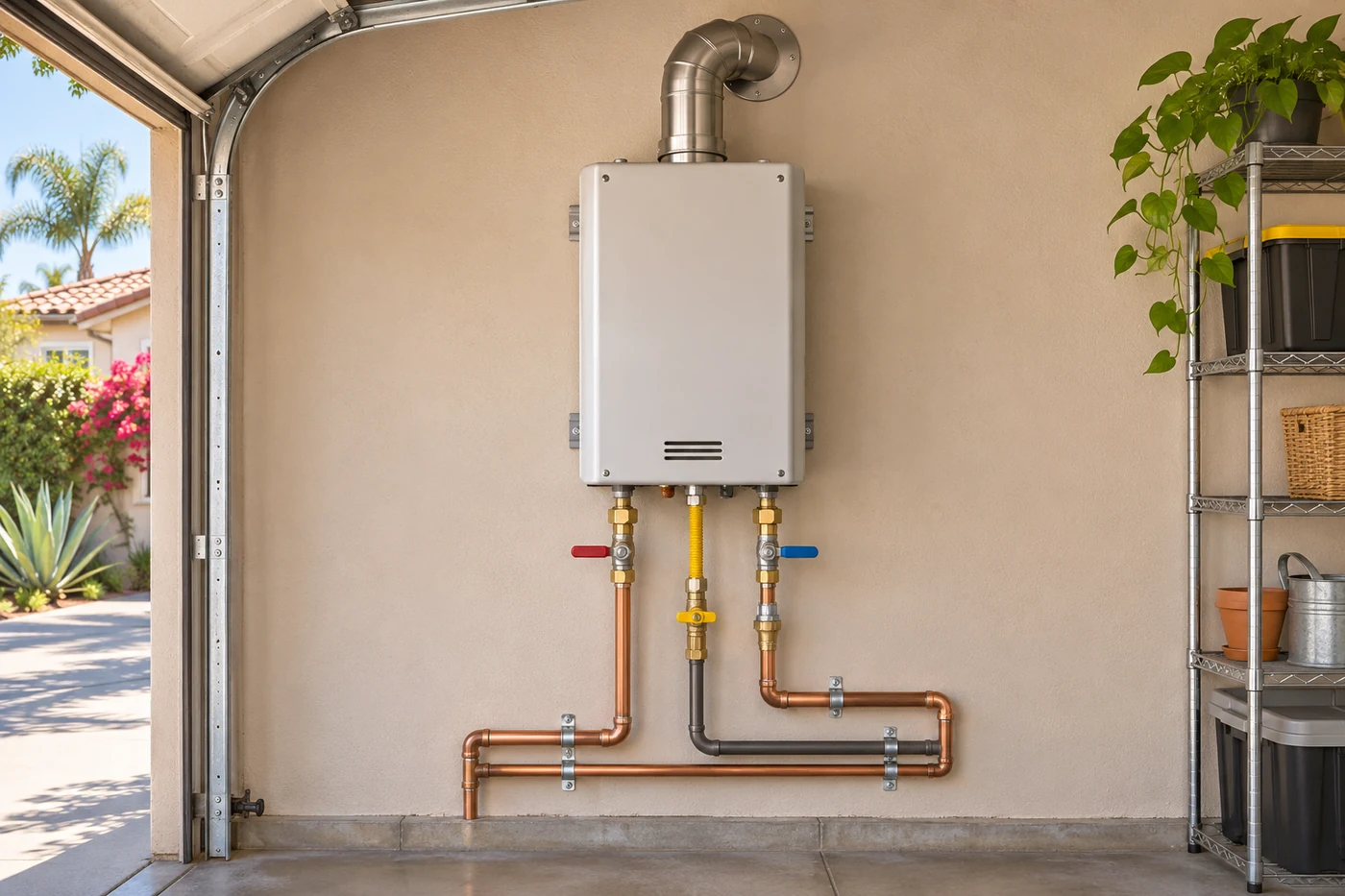
By Extreme Plumbing & Rooter · Cover image is illustrative.
Two showers run at the same time. One goes lukewarm as soon as the other starts. That can happen with a tank that has used up its stored hot water. It can also happen with a brand-new tankless heater sized for one shower instead of two. The best time to find out which model your house needs is before the old one comes out.
For a tankless water heater installation in Glendale, Studio City or Van Nuys, start with three numbers: your simultaneous hot-water demand, the temperature rise the unit has to deliver, and the hardness of the water reaching the heater. The rest of the estimate should explain how the installer will accommodate those numbers in your house.
How hard is the water at your address?
Hardness measures dissolved minerals, mainly calcium and magnesium. Heating hard water can leave scale on surfaces inside a heater. In a tankless unit, scale can build up in the heat exchanger and restrict flow or interfere with heat transfer. A storage tank can accumulate mineral deposits and sediment too. Popping sounds from a tank, fluctuating hot water or lower hot-side flow are reasons to investigate. Each can have more than one cause.
LADWP’s published FAQ reports a 2022 average of 8.6 grains per gallon for its San Fernando Valley and Western Los Angeles area, with readings ranging from 5.4 to 16.1. Treat that as historical context for LADWP customers in places such as Studio City and Van Nuys. Glendale Water & Power publishes its own reports and uses a mix of sources. Use your own utility information and an on-site sample to pick a maintenance plan.
If the house already has treatment, ask for a sample from the water feeding the heater. An outdoor hose bib may be upstream of a softener, and a kitchen tap could have separate treatment. Keep the test result with the model manual. That makes it possible to check the manufacturer’s thresholds for service and water treatment later.
How do you size a tankless water heater?
Tankless capacity is measured in gallons per minute at a specific temperature rise. The rise is the difference between incoming water temperature and the target heater outlet temperature. A model that looks generous on the box may deliver less flow at a larger temperature rise. The U.S. Department of Energy’s tankless installation guide recommends sizing for peak simultaneous demand and the required rise.
For example, if water enters the heater at 55°F and the design uses a 120°F outlet, the heater has to supply a 65°F rise. If the household needs about 4 gallons per minute of hot water at that moment, ask the installer to point to at least that capacity at a 65°F rise on the manufacturer’s curve. Actual hot-water demand at a mixed fixture is only the hot portion of its total flow. This example shows how to read the curve. A site assessment accounts for the plumbing, fixtures and inlet conditions.
Think about real overlap. If two adults shower before work and the laundry usually runs later, size around the two showers. If the house includes a large soaking tub or a regularly occupied ADU on the same supply, discuss those loads. Ask about minimum activation flow too, especially if a low-flow lavatory is the only fixture running.
Tank versus tankless for a Valley home
| What matters | Storage tank | Tankless |
|---|---|---|
| Peak use | Stored water helps meet a burst of demand. Compare first-hour rating and recovery. | Can heat continuously within its flow and temperature-rise capacity. |
| Project scope | A like-for-like replacement can be simpler if existing connections are suitable and compliant. | A conversion can involve gas or electrical upgrades, venting and condensate routing. |
| Space | Needs floor space and access for service or eventual removal. | Typically wall-mounted, with manufacturer clearances and room for service valves. |
| Hard-water maintenance | Ask about the maker’s sediment and anode service instructions. | Ask about isolation valves, descaling frequency and water quality limits for the exact model. |
A Glendale family with back-to-back showers may get real use from a correctly sized tankless unit. A Studio City homeowner with a failed tank, suitable existing connections and a short replacement window may prefer a straightforward storage replacement. If the house is already set up for electric water heating, ask about a heat pump storage model as another option when space, ventilation and electrical service make sense.
Also separate “continuous” from “instant.” There is still cooled water sitting in the line to a distant bathroom. A tankless heater alone will leave that wait largely in place. If the far shower is the frustration, ask how far it is from the proposed heater and whether an on-demand recirculation design makes sense for the plumbing and the model.
What does a tankless installation cost?
For a broad Los Angeles reference, Angi reports roughly $1,600 to $3,800 across its common project range. A Los Angeles contractor’s published guide lists $6,000 to $13,000 for its installed whole-home tankless category. Those sources cover different mixes of work. Use the ranges to frame questions. Extreme’s estimate depends on the proposed model and what has to change at the property.
Two quotes for the same heater can be thousands apart if one includes a new gas run, a vent route, an outlet and a condensate drain while the other assumes the hookups are ready. Ask for the model number, rated output at your required rise, fuel or power work, venting, valves, permit handling, removal of the old heater and testing. Find out which trades are responsible if a panel, meter or finish needs work.
The permit office follows the property address. Glendale has its own permit application guidance. For Studio City and Van Nuys addresses in the City of Los Angeles, see LADBS homeowner permit guidance. Ask who will schedule inspection and what the proposed price includes.
What happens during installation?
- Check the house and equipment. Confirm demand, inlet temperature, gas or electrical capacity, water condition and the proposed equipment location.
- Plan the connections. The installer checks the exact model’s venting, clearances and electrical requirements. Condensing gas models also need a plan for condensate disposal.
- Make future service accessible. Ask to see where the isolation and service valves will go. They need to be reachable for the maintenance the heater actually requires.
- Run the fixtures together. At handoff, ask the installer to demonstrate the setup under the conditions you discussed. Keep the model, serial number, warranty, operating instructions and service schedule.
Good preparation can prevent a surprise on installation day. The Pacific Northwest National Laboratory installation checklist covers water hardness, available electrical supply and gas-line capacity among its pre-installation checks. When the planned heater is electric, have the installer evaluate the demand on the panel before committing to the model.
How often should you descale?
Use the model’s service instructions and your measured hardness. An annual flush is a common starting point for some residential tankless models where scale is a concern, and some conditions require more frequent service or treatment. Ask for the schedule in writing and check what the installer charges for routine service. Keep the first service date with your warranty paperwork. Scale can accumulate before you notice an error code, particularly when untreated water is hard. Check the warranty’s water-quality provisions before choosing treatment.
A properly selected softener can reduce hardness minerals. Discuss testing, maintenance, equipment location and which water lines will receive treatment. If the existing heater has low hot-water flow, ask the technician to check for scale, a restricted inlet screen, fixture problems and other causes before assuming the heater has reached the end of its service life. If a tank has an active leak or water is near electrical equipment, keep clear of electrical hazards and call for service. If you smell gas, leave immediately and call 911 and SoCalGas at 1-800-427-2200 from a safe location. See SoCalGas emergency guidance.
Frequently asked questions
Can a tankless unit run two showers at once?
Yes, if it can deliver their combined hot-water demand at the required temperature rise. Ask to see the model’s flow curve and have the installer test the setup under simultaneous use.
Does a tankless heater work during a power outage?
Electric tankless heaters need power. Most modern gas tankless units also need electricity for ignition and controls. Check the specific model if outage performance matters to you.
Do I need a softener for tankless?
It depends on the hardness reaching the heater and the model’s water-quality requirements. Test at the heater feed, then compare the result with the manufacturer’s recommendations.
Should I convert if the old tank just failed?
Ask for the first workable tank replacement and a separately scoped tankless conversion. Compare how long hot water will be out, which infrastructure each option needs and what maintenance you can plan for.
Get a quote sized to your house
Extreme Plumbing & Rooter provides tank and tankless water heater service in Glendale, Studio City, Van Nuys and nearby communities. Call 818-631-7296 or request a free inspection. Tell us how many showers need to run at once and where your existing heater sits.