
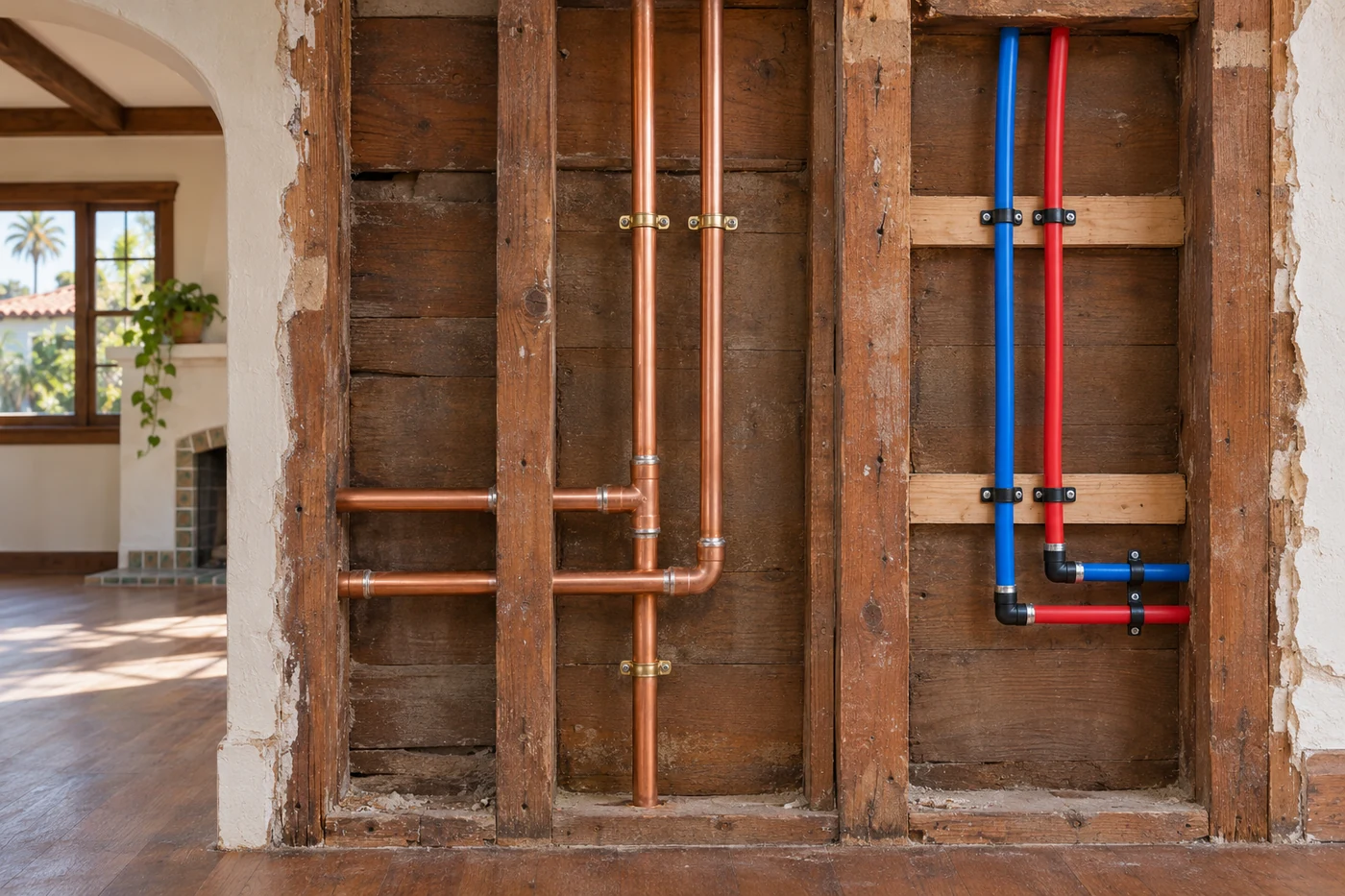
By Extreme Plumbing & Rooter · Cover image is illustrative.
You turn on the kitchen faucet and the water looks normal. Then someone starts a shower, and the kitchen stream drops to a trickle. If that happens at several fixtures in an older Van Nuys house, the useful question is where the flow is being lost. A worn pressure regulator, a partly closed valve and galvanized pipes that have narrowed from the inside can all feel the same at the faucet. They lead to very different estimates.
A whole-house repipe replaces the pipes that carry hot and cold water to your fixtures. In a San Fernando Valley home, the decision usually comes down to how much of the old system is failing, where new lines can run, and which surfaces will have to be opened. Get those three answers before choosing copper or PEX.
How do you know if the whole house needs repiping?
Look for patterns across the house. One slow bathroom sink can be a clogged aerator or a worn fixture. Weak flow across two bathrooms and the kitchen, especially when several taps run at once, deserves a system-level check. A plumber can compare pressure when the water is off with what happens while fixtures are running. A normal static reading can coexist with poor flow under demand.
- Rust-colored water at several cold taps. Note whether it clears and whether it happens after the water sits overnight. Old steel piping can contribute rust, but a utility disturbance can produce discoloration too. Hot-water-only discoloration narrows the investigation toward the heater or hot-side piping.
- Leaks keep appearing in different places. One failed fitting can be isolated. Separate pinholes or failures on multiple branches make the condition of the remaining pipes part of the decision.
- The meter moves when everything is off. Check that irrigation, ice makers and automatic equipment are idle. The movement can point toward a leak somewhere on the property. It cannot tell you which line is leaking.
- A floor stays warm or damp without an obvious source. In a slab home, a warm area can be a clue involving a hot supply line. Other heat and moisture sources can look similar. Ask about slab and hidden leak detection before opening flooring.
Write down which rooms are affected and whether the trouble occurs on hot, cold or both. A short video showing the flow drop when a second tap opens is more useful than a description of “bad pressure.” If water is actively escaping, shut off the supply if you can reach the valve safely and call for help.
What happens inside old galvanized and copper lines?
Galvanized steel has a protective zinc coating. As that protection wears down, corrosion and deposits can restrict the opening from the inside. An exposed section can look reasonably intact while the flow path inside is much smaller. In a remodeled North Hollywood house, fresh pipe under the new kitchen sink may connect to an older steel trunk behind a wall. The visible fixture connection tells you only what was installed at that fixture.
Copper has different failure patterns. Repeated pinholes deserve an evaluation of the pipe, its route and operating conditions. Green staining near a joint can come from surface oxidation, residue or moisture. A wet spot that returns after drying, or several isolated patches with a history of leaks, gives the technician more to investigate. Mineral scale and metal corrosion are different processes. The LADWP water-quality FAQ describes how hardness varies with the local water supply. A hardness number by itself cannot diagnose copper failure.
Type L copper or PEX?
Start with the proposed route. A relatively straight, accessible garage or crawlspace run presents a different job from a series of tight turns behind finished plaster. Ask both bidders to describe the same route and fixtures. That makes the material comparison meaningful.
| What to compare | Type L copper | Potable-water PEX |
|---|---|---|
| Routing | Rigid tubing lends itself to straight, neatly supported runs. Direction changes typically use fittings. | Flexible tubing can make some turns without a fitting and can be easier to route through select finished areas. |
| Material concerns | Metal tubing requires compatible joints and protection where the installation calls for it. Water chemistry and system conditions matter. | Plastic tubing avoids metal-wall corrosion. Its fittings and fixtures can still collect deposits. Protect the tubing from sunlight and follow the system listing. |
| What to ask for | Specify tubing type, joining method and treatment of transitions to any remaining pipe. | Specify listed tubing, compatible fittings, supports and accessible shutoffs where planned. |
A PEX bid can involve fewer openings when the installer can pull longer runs through reachable cavities. Tile showers, blocking in wall cavities and inaccessible drops can still require cuts with either material. With copper or PEX, sizing matters at least as much as the label. A long run that feeds multiple fixtures needs to handle their combined demand. For material background, see the Copper Development Association’s Copper Tube Handbook.
What does a Van Nuys or Sherman Oaks repipe cost?
For a broad planning reference, Angi’s Los Angeles cost guide reports about $1,700 to $17,000 across repiping projects, with a midpoint around $8,500 in its published data. That covers different project sizes. At the other end, a Los Angeles contractor’s published pricing guide lists $23,000 to $56,000 or more for its whole-home repipe category, with access and patching among the variables. These are third-party figures with different scopes. Extreme’s price comes from the site visit and written estimate.
A partial repipe might cover the accessible hot branch serving one bathroom. A whole-house quote should identify which fixture branches and trunks are included. Ask separately about the water service from the meter, hose bibbs, heater connections, detached units and any circulation line. A bid that stops at the house shutoff and one that includes a new line from the meter can look identical at first glance.
For a better comparison, ask for permit handling, pressure testing, cleanup and finish repair to appear in writing. “Patch included” can mean closing the drywall openings with basic joint compound. Matching plaster texture, paint, tile, trim or cabinetry can be separate work. In a finished Sherman Oaks home, those exclusions can matter more to the final bill than the per-foot price of the pipe.
How does a repipe work in a slab home?
A house on a slab can sometimes be repiped by routing new supply lines through walls, a garage ceiling or accessible attic space. That can spare a finished floor when there is a workable alternative path. The plumber should explain where each line will drop down to a fixture, how lines will be protected and supported, and what happens to the abandoned run. If the only practical route crosses a finished surface, ask to see the proposed opening before approving work.
- Confirm the problem. Check accessible materials, flow under demand and signs of leakage. When needed, isolate the affected supply line. A drain camera is for the waste line and answers a separate question.
- Walk the route together. Identify planned openings, water shutoffs and areas where possessions need to be moved. Ask who handles permits and when inspections fit into the schedule. In the City of Los Angeles, LADBS homeowner guidance lists residential repiping in its express permit workflow.
- Install and test. The crew isolates the affected piping, installs the new runs, pressure-tests the system and checks the fixtures before closing the work area.
- Review the handoff. Locate your main and branch shutoffs, keep the written scope and photos, and confirm who completes each patch. Ask how the new piping is supported and protected where it passes through framing in earthquake country.
Many households can stay during a straightforward repipe if daytime water outages and the end-of-day service plan are workable. A small accessible home might need a few working days for plumbing. Larger properties, inspections and finish work can extend the overall schedule. If someone in the house needs reliable daytime water, ask for an outage plan before the start date.
When is a spot repair the sensible move?
A single failed fitting on an otherwise sound system can justify a targeted repair. A failing buried branch with reliable piping elsewhere may be a candidate for a reroute. Several leaks in separate areas, broad flow restriction or old galvanized sections spread through the house make a full repipe more worth pricing. Ask what remains after each option and how hard it would be to reach that pipe later. That is how you compare today’s bill with the disruption of opening the same rooms a second time.
After the repair, know where the main shutoff is, address leaks early and have abnormal pressure evaluated. If you add a filtration or softening system, ask how it will affect flow and maintenance. For a combined project, see our water heater service and discuss which connections are included in each scope.
Frequently asked questions
How long does a new copper or PEX repipe last?
Both are long-service materials when correctly selected and installed. Actual life depends on water chemistry, operating pressure, temperature, workmanship and exposure. Ask for the written workmanship warranty and the specific product warranty.
Will homeowners insurance pay for a repipe?
Coverage depends on the policy and the cause of loss. The decision about resulting water damage can differ from the decision about replacing deteriorated pipe. Document the failure, prevent additional damage where safe and ask your insurer which costs it covers.
Do I need to replace the drains at the same time?
Supply piping and drainage are separate systems. If an open wall exposes an aging drain, ask the plumber to document its condition and price any drain work separately.
Can you estimate my repipe from a photo?
Photos help identify visible pipe and access. An on-site inspection can show how the fixtures are fed, what old pipe remains and which walls or floors the work may affect.
Find out which pipes actually need work
Extreme Plumbing & Rooter serves Van Nuys, North Hollywood, Sherman Oaks and nearby communities. Call 818-631-7296 or request a free inspection. Ask us to walk you through the repair and repipe options and give you the scope before work begins. See our copper repipe service for details.